Most people who’ve heard of alien abduction accounts know about the Grays. Small. Large eyes. Clinical.
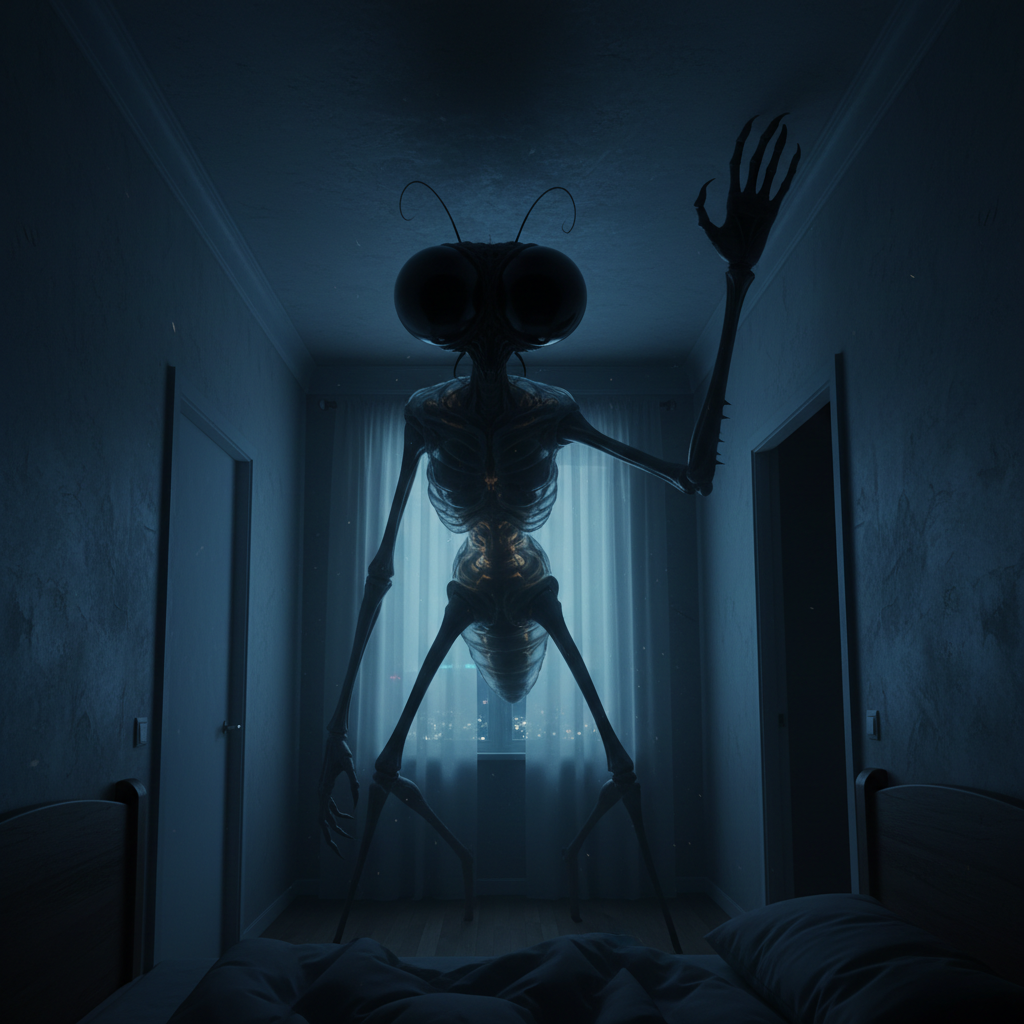
Almost nobody talks about the other species that appears in the documented accounts. The tall ones. The ones described as looking like a praying mantis — six feet tall or more, with elongated limbs, a triangular head, and eyes that witnesses describe as ancient in a way that’s hard to explain.
The Mantis type appears in hundreds of documented contact and abduction accounts across decades and continents. And they consistently appear in one specific role: as the ones in charge.
What the Accounts Actually Describe
The Mantis type — called ‘Insectoids’ in some government files and ‘Arthropods’ in others — is one of the most consistently described non-Gray entities in the documented contact literature. Physical descriptions across unconnected accounts are remarkably uniform.
Six to seven feet tall, extremely thin, with elongated limbs that have an additional joint not present in human anatomy. The head is triangular — wider at the top, coming to a narrow jaw. The eyes are large, compound-appearing, often described as green or amber. The skin or exoskeleton is described as brown, gray-green, or chitinous — like the outer shell of an insect scaled up to human height and then some.
The most consistent behavioral description across all documented accounts: calm, authoritative, and clearly hierarchically superior to the Grays that frequently appear in the same encounter. Witnesses describe Grays deferring to the Mantis being, waiting for direction, physically moving out of the way when the Mantis approaches.
If the Grays are the technicians running the procedures, the Mantis beings are the supervisors deciding which procedures run.
What the Government Files Say
The AARO’s classified files — portions of which have been released through the 2024-2026 declassification batches — reference ‘arthropod-type NHI’ in multiple documented military encounter accounts.
The most significant reference comes in a classified memo from 2019, describing an encounter between military personnel and non-human entities during a classified operation. The memo, now partially declassified, describes a tall, insectoid being that communicated with military personnel through what the report describes as ‘direct cognitive interface’ — thought-to-thought communication without spoken language. Not telepathy in the science fiction sense. A functional technology or biological capability that bypasses language entirely.
The military personnel involved were debriefed extensively. Their accounts were documented in detail. The memo concludes with a classification recommendation and a note that the account ‘is consistent with prior reports from the 1980s and 1990s, suggesting recurring contact with the same or similar entities over multiple decades.’
Recurring contact. Decades. The same beings — or the same type of beings — making contact with U.S. military personnel across at least three decades, and the public never knew.
Why They’re Rarely Discussed
The Mantis type is underrepresented in public discourse for a specific reason: their accounts are among the most classified, and for good reason from the government’s perspective.
Gray encounters are disturbing but manageable within existing cultural frameworks — they fit the ‘alien abduction’ narrative most people are familiar with. Nordic encounters are unusual but non-threatening in surface presentation. But Mantis encounters consistently describe beings who demonstrate cognitive capabilities that significantly exceed human capacity — beings who can directly access and manipulate human neural processing.
That capability, if real, represents a threat category that goes well beyond physical contact. It raises questions about the integrity of human decision-making in the presence of these beings. Questions about whether military personnel who’ve had Mantis contact can be trusted with classified information afterward. Questions that intelligence agencies don’t want to answer publicly because there’s no good answer to give.
The Hierarchy Question
Multiple researchers who’ve analyzed the full body of documented contact accounts have noted a structural pattern: the non-human intelligences don’t appear to operate as a single unified group. They appear to have an internal hierarchy.
Grays are the most commonly encountered — the workers. Nordics appear to operate more independently with their own separate agenda. Reptilians maintain territorial claims over underground domains. But the Mantis type appears across all of these categories, consistently in positions of authority and oversight.
The pattern that emerges from the documented accounts, analyzed without the filter of preconception, suggests something uncomfortable: these species are not independent actors. They’re operating within a structure. And the Mantis type appears to occupy a position near or at the top of that structure.
That changes the calculus of preparation significantly. Because it means understanding any one species in isolation gives you an incomplete picture of what you’re actually dealing with.
What This Means for Preparation
Understanding the Mantis type matters for one specific, practical reason: if you’re ever in a contact situation involving multiple entity types — which the documented accounts suggest is common — the Mantis being is the decision-maker. Directing your attention to the Grays in that situation is like trying to negotiate with an employee while ignoring the executive in the room.
The documented accounts involving Mantis beings also consistently report more severe cognitive disorientation than other contact types. Witnesses describe time distortion that’s more extreme than typical missing time, memory gaps that are more complete and harder to recover through regression, and a prolonged period of disorientation following the encounter that can last days.
If you’re in a Mantis encounter, what happens afterward may be as important as what happens during. Document everything immediately when the encounter ends — before the memory degradation sets in. The survival guide includes a post-encounter documentation protocol specifically developed from these accounts.