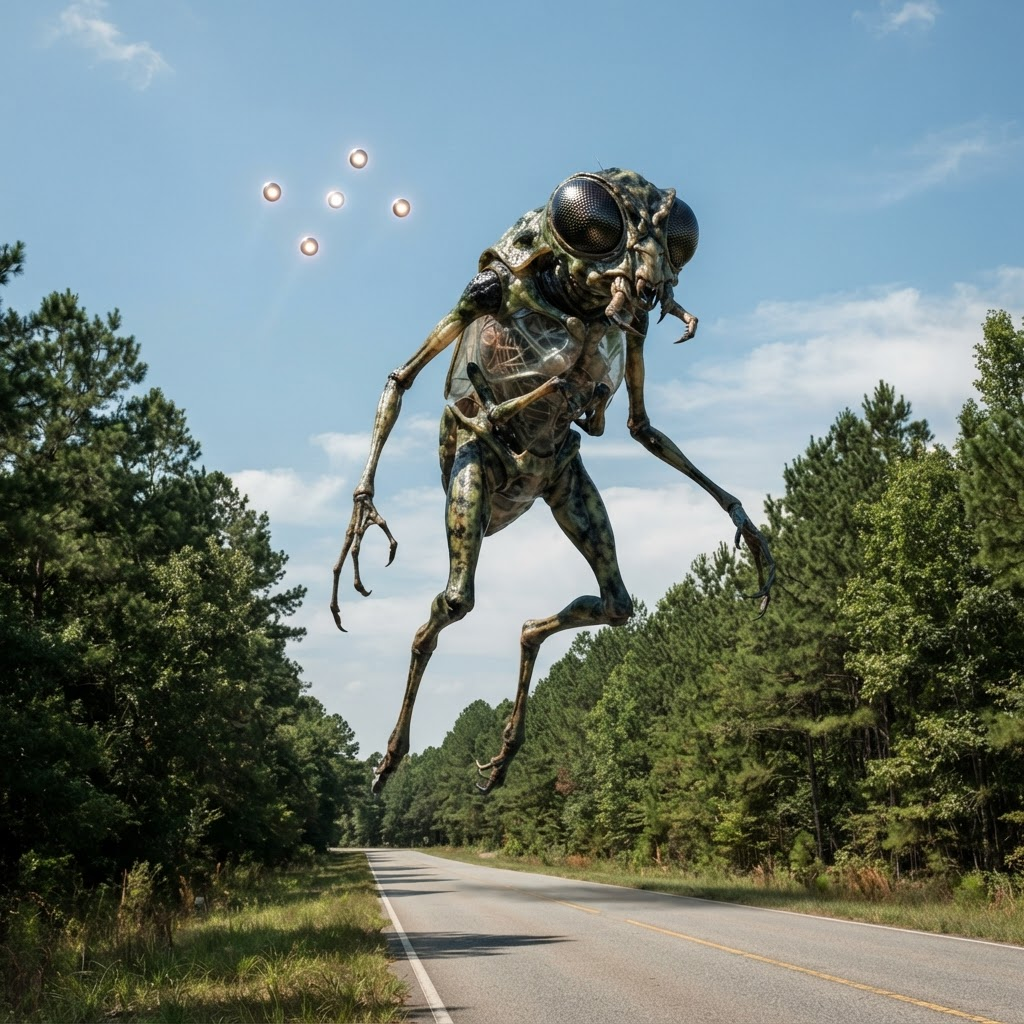
You are driving a quiet road when five lights appear above the trees. They hold formation without sound, without smoke, and without changing distance from one another. Then something much worse moves beneath them.
That is the detail that should keep you awake. Not the familiar argument over whether a bright object is a balloon, a drone, or a trick of perspective. The real fear begins when the object seems to operate as part of a system — a system that can arrive, observe, and disappear without giving you a safe explanation.
The New Files Are Not the Comfort People Wanted
The latest Pentagon release in the government’s continuing UAP disclosure push has put more images, videos, reports, and artistic renderings in front of the public. The headlines focus on the volume of material. They talk about transparency. They talk about old cases finally being made available.
But transparency is not the same thing as understanding.
When you see a strange object in the sky, you want three basic answers. What was it? Where did it come from? And what can it do? A file can preserve a witness statement without answering any of those questions. A photograph can prove that something was recorded without explaining what was moving through the frame.
That gap is where the danger lives.
You are being trained to think of unexplained objects as a debate. One side says visitors. The other says mistakes, secret aircraft, weather, or camera artifacts. While those arguments continue, the most important practical question gets ignored: what should an ordinary person do when the strange thing is no longer far away?
Five lights moving together are not automatically proof of an invasion. But they are a warning that your assumptions may be useless. If the object can violate the rules you rely on for distance, speed, sound, and direction, then your normal response plan may fail before you realize there is a problem.
Why Formation Matters More Than the Light
A single glowing point can be dismissed. Human beings are good at turning ambiguity into something familiar. A single light becomes an aircraft. A cluster becomes a satellite train. A flash becomes atmospheric activity.
Formation changes the question.
When multiple objects keep a deliberate pattern, observers naturally look for coordination. Are they communicating? Are they escorting something? Are they searching? Or are they simply part of a larger vehicle that is difficult to see?
The public cannot answer those questions from a short clip. Neither can a person standing on a shoulder with a phone in one hand and a steering wheel in the other. That is why the most unsettling cases often leave witnesses with less certainty after they report them than before.
The event is real enough to interrupt a life. It is not clear enough to fit inside an explanation.
And if you are close enough to see the object’s surface, your problem is no longer identifying a light. Your problem is deciding whether to remain visible.
The Face Behind the Phenomenon
People prefer machines. A machine can be studied. A machine can be tracked. A machine can be damaged, recovered, or reverse-engineered. The moment a visible face appears, the entire situation changes.
It means the question may not be whether something is flying overhead. It may be whether something is looking back.
That is the detail most people are not prepared to process. You can tell yourself that a distant orb is harmless. You can tell yourself that a strange craft is only passing through. It becomes much harder to maintain that distance when the witness sees a shape inside the event — eyes, a head, a body, or an intelligence reacting to the observer.
There is no responsible way to claim that every reported face is genuine. Witnesses can misinterpret shadows. Images can be corrupted. Fear can fill in missing details. But preparation does not require certainty. A fire plan is useful before you know whether the smoke came from a kitchen accident or an electrical fault.
The practical rule is simple: if an unknown object appears near your home, do not assume curiosity means safety.
- The first mistake is standing in the open because you want a better video.
- The second mistake is approaching a landed object before you know whether the air, sound, or electromagnetic environment has changed.
- The third mistake is believing that a calm appearance means a calm intention.
What You Can Actually Control
You cannot control what the Pentagon releases. You cannot control whether officials explain the most disturbing detail. You cannot control whether a sighting becomes public, disappears into a database, or gets reduced to an argument online.
You can control your first few decisions.
Move away from the brightest and most exposed location. Do not use a laser, weapon, drone, or signal to provoke a response. Bring other people indoors without creating a panic stampede. Record only if you can do so without remaining in the open. Note the time, direction, weather, sound, and behavior. Most importantly, do not treat a close encounter like a once-in-a-lifetime sightseeing opportunity.
The reason these steps matter is not that they prove an alien threat. They matter because they reduce your exposure to an unknown threat. That distinction is important. You do not need to settle the origin of an object before protecting yourself from its effects.
If a phenomenon disrupts power, communications, navigation, animals, or human behavior, the event has already become more than a strange light. If people nearby report missing time, nausea, burns, pressure, unusual sounds, or sudden confusion, separate witnesses, get inside, and seek medical help when needed. Do not let embarrassment delay a safety decision.
The Detail They Still Cannot Explain
The strongest part of the new release is not the most dramatic image. It is the pattern that keeps returning across decades: witnesses describe objects that appear to move without the cues that make ordinary aircraft understandable, while official explanations remain incomplete or arrive long after the fear has passed.
That does not prove a nonhuman origin. It does prove that the public conversation is still operating with missing pieces.
And missing pieces are dangerous when people are forced to make decisions in real time.
Imagine the next report is not five distant lights. Imagine the formation stops above a neighborhood. Imagine every phone loses signal at the same moment. Imagine a dark figure appears at the edge of the road and does not move like a person.
Would you know where to go? Would everyone in your home know what not to do? Would you have enough supplies to stay quiet, inside, and independent while you determine whether the event is passing or spreading?
Most people would not. They would search for answers after the first warning, when the networks are overloaded and everyone else is searching too.
Three Questions You Should Ask Before the Next Sighting
First: where is the safest interior location in your home, away from windows and exterior doors? Choose it now, not while something is hovering outside.
Second: how will your household communicate if cell service fails? Pick a meeting point, a backup contact, and a simple rule for returning home.
Third: what would make you leave instead of shelter? A fire, structural damage, toxic air, or repeated activity near the property should trigger a planned evacuation rather than a debate.
These questions are not an admission that every UAP is hostile. They are basic preparation for a world in which you may not receive a clean explanation before you need to act.
The newest files add pieces to a picture that remains unfinished. They may eventually reveal ordinary causes. They may reveal advanced human technology. They may reveal something that forces everyone to rethink what “alone” means.
Until then, the most dangerous choice is waiting for certainty.
Because if the lights hold formation, if the silence reaches the road, and if the face turns toward you, the time to prepare will already be gone.